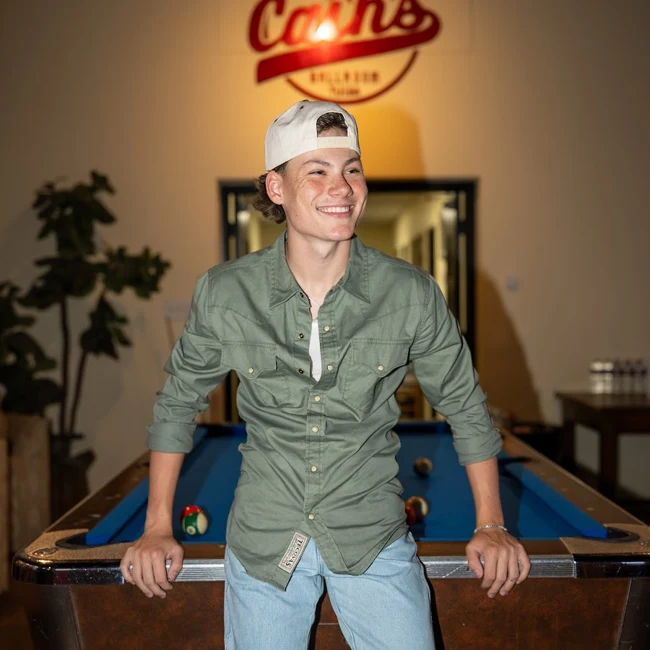
About Taylor Swift
Taylor Swift is a singer and songwriter who began in Nashville’s country music industry and went on to make records in pop, folk, and rock settings. She released her first album as a teenager. Fearless brought “Love Story” and “You Belong With Me” to a much wider audience, and 1989 made a full turn toward pop with singles such as “Shake It Off” and “Blank Space.” On Folklore and Evermore, she used quieter arrangements and stories told by characters to explore another side of her writing.
Swift won the Grammy for Album of the Year for Fearless, 1989, Folklore, and Midnights. Her Eras Tour organized a career’s worth of songs into scenes built around individual records. She also recorded new editions of four earlier albums as Taylor’s Version, adding tracks that had stayed in the vault during their initial releases.
Fun Fact
Swift wrote all the songs on the original standard edition of Speak Now herself. She was still a teenager when she began writing the album.
Family and Associates
Swift’s parents, Scott and Andrea, moved with the family to Tennessee to support her work. Her brother Austin has acted and produced. Longtime creative partners include Jack Antonoff and Aaron Dessner.
Detailed Biography
A songwriter in Nashville
Taylor Alison Swift was born on December 13, 1989, in West Reading, Pennsylvania. She spent part of her childhood on a Christmas tree farm, an experience she returned to on a Christmas single years later. She took an early interest in country music and began visiting Nashville. Her family moved to Tennessee when she was a teenager, and she began writing with professional songwriters. Her working relationship with Liz Rose helped shape material on the first album, including songs built from the small decisions and social pressures of high school.
Swift signed with Big Machine Records and released her self-titled album in 2006. Its first single, “Tim McGraw,” connects a hit by another performer with a relationship that has ended. She gave teenage narrators concrete things to remember and often wrote the chorus as the one statement they wanted someone else to hear. Fearless expanded that style. “Love Story” rewrites the ending of Romeo and Juliet, while “You Belong With Me” makes a case for a friendship to become something else. The album won Album of the Year at the 2010 Grammy Awards.
From Speak Now to 1989
Swift wrote Speak Now without co-writers, recording songs that made room for details and changes of perspective beyond what she could fit into one radio single. On Red, she gave herself more freedom to change the sound around the writing. The record places acoustic storytelling beside songs made with Swedish pop producers Max Martin and Shellback. “We Are Never Ever Getting Back Together” became her first number one on the Billboard Hot 100. “All Too Well,” which was an album track at the time, stayed important to listeners and later returned in a longer version.
In 2014, 1989 made the move to pop the premise of an entire album. “Style” treats the return to a relationship as an inevitability, and “Blank Space” uses an exaggerated character to play with the way the media portrays Swift’s private life. The record earned her a second Album of the Year Grammy. On Reputation she moved into darker electronic production and some of the same songs contrasted the pressure of public attention with the privacy of a developing relationship. Lover returned to a warmer palette while keeping room for the softer guitar-based writing of songs like its title track.
Fictional narrators and another change in scale
Folklore arrived in 2020 with little advance notice. Swift worked with Aaron Dessner and Jack Antonoff, with Dessner’s arrangements giving several songs a spacious, subdued setting. The songs “Cardigan,” “August,” and “Betty” take different perspectives on three young people involved in the same relationship story. Evermore followed later that year and included the family tribute “Marjorie,” about Swift’s maternal grandmother, who was an opera singer. By writing from the viewpoints of characters and people she had known, Swift extended the kind of narrative work she had already done in her early songs.
Midnights brought her back toward electronic pop. “Anti-Hero” gives a sharply self-critical narrator a chorus that people can sing back at arena scale. The record made Swift the first performer to win the Album of the Year Grammy four times. The Tortured Poets Department followed in 2024, and The Life of a Showgirl in 2025 reunited her with Max Martin and Shellback. Those albums share a writer but organize the listening experience differently, with the sparse sequences of Folklore giving one set of songs more space and the bright arrangements of 1989 or Showgirl giving another set a more immediate shape.
A tour through the catalog and control of the recordings
The Eras Tour staged much of Swift’s catalog in a single evening, giving albums their own instrumentation, visual design, and costumes. Some records had never been the focus of a dedicated tour, and the set changed to accommodate additional material. Her concert film took the format into theaters. As a live project it depended partly on listeners understanding which sounds went with which albums, and partly on how familiar they were with the less obvious songs that appeared in the acoustic section.
The bonus songs also gave the rereleases a story of their own. Swift and Antonoff had worked on “Is It Over Now?” during the original 1989 sessions, but listeners first heard it as a vault track on 1989 (Taylor’s Version). It became a number-one song in the UK in 2023. A track that had once been left off an album was able to lead a new release campaign nine years later.
Swift had begun rerecording her earlier albums after the original master recordings were sold. Four editions arrived as Taylor’s Version. They accompanied faithful rerecordings with new releases of material written around the time of the original albums. In 2025 she purchased the original masters of her first six albums, bringing those recordings under her control as well. The project made a distinction visible to listeners who had never encountered music contracts before. Owning a song as its writer and controlling the particular recording of that song are different rights, even when the artist people hear on the record helped create both.
Sources
- Recording Academy discography guide
- Recording Academy awards history
- Biography.com profile
- Reuters reporting on the masters
Portrait by TenthAvenueFreezeOut · CC BY-SA 4.0 · cropped for display